Tuesday, June 12, 2012

Shroud of Turin Lecture in Video Format

Hello all,

Sorry for the lack of posts. My job that I have been pre-occupied with for the last 10 months has ended and I will be able to start writing more. I come to you with videos though; I have recorded myself reading my Shroud of Turin Lecture, while adding in a few notes here and there, including a brief response to collinsbarry 'scorch-o-graph' theory. Enjoy!


Labels: , , , ,

Saturday, February 25, 2012

Shroud of Turin Lecture

Hello everyone,

So roughly a week ago I compiled all the posts I've done on here together into a lecture format for a hopeful upcoming presentation I'll be giving on the Shroud of Turin and its acting as evidence for the Resurrection. This contains not only all the material I've done with revisions and some additions, but two new sections on the work of Walter McCrone vs Adler and Heller, but a brief reconstruction of the Shroud's journey throughout history. While it is still only in a draft form, it takes about an hour and a half for me to read out loud, which may be a little long. I'm really looking for feedback so that this can be as best as it can be. Thank you, and please look at it via the link!

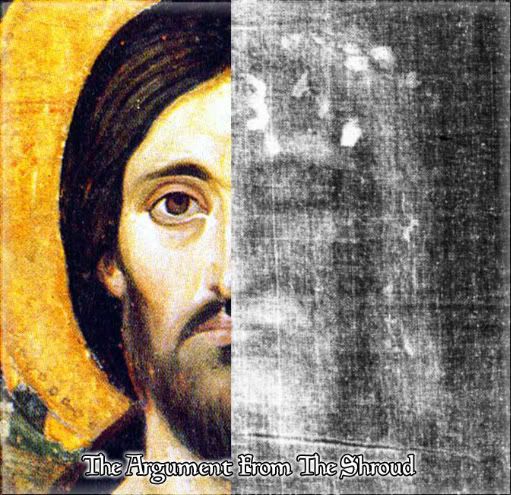
The Argument From the Shroud [Lecture]

Labels: ,

Sunday, January 29, 2012

The Argument From the Shroud 3-A: 'O Death, where is thy sting? O Hades, where is thy victory?'


At this point in the argument I am going to assume that the Shroud of Turin is indeed the burial shroud of Jesus Christ. The posts up to this point have largely been a justification for this assumption. The real excitement about the Shroud is when we start to examine it in the light of Pascha.

There already exists voluminous studies on the Resurrection and what the apostles saw, largely in the camps of criticism and apologetics. My contention all along is that the Shroud adds unprecedented weight to the claims of the apologists, not only confirming the written record of the Gospels but giving us a primary document which supplies us with far more information than we had previously.
Why then, a Resurrection? Couldn't we just say that the image of Christ was made via a naturalistic process and that as eerily and unique it may be (eerily perhaps because of it's uniqueness) it does not prove the Resurrection? Yes and no.

Yes in the sense that I am not arguing that this proves the Resurrection. I don't know if I can do that, or if anyone can do that, but what I will say is that it makes it seem logically possible. So much so to the point where I believe that the Resurrection is a more powerful explanation for both the events surrounding Easter and the Shroud than any naturalistic one.
No in the sense that even if there were to be a purely naturalistic explanation for the image, it would be irrelevant to what I just claimed. I will elaborate on this further when I talk about the properties of the Shroud and how they pertain to the different image forming hypotheses. However, first we must lay the context of the claim.

To explain the rise of early Christian belief, there are some key factors that any hypothesis must take into account. I will essentially be touting the typical evangelical apologetic given by figures such as William Lane Craig, Gary Habermas, etc.

Firstly, the apostles of Christ claimed to have seen their Rabbi after His death and believed that He was truly Risen from the dead. I am putting emphasis on 'Risen' as there have been many theories that the early Church did not believe in a bodily resurrection, but that such a dogma came later and was anachronistically forced upon earlier writings.[1] However, scholars such as N.T. Wright have shown this to be an erroneous claim.[2] In a similar vein, there's been many (bad) attempts to show that Christ was just a copycat savior from preexisting mythology. However, the very concept of the bodily resurrection – the word 'anastasis' – flew in the face of everything that the Hellenic world imagined.[3] Also, there have been many works that have debunked such theories, such as the apologetics of James Patrick Holding, or Edward L. Winston's criticism of the popular internet movie 'Zeitgeist'.[4]
Yet, the visions themselves wont convince most skeptics. After all, people have visions of things frequently, and in an ancient world that did not have the sciences people had to of been more prone to be duped by hallucinations, right?

While the assertion may seem reasonable to us in our post-modern age, the ancients were actually quite skeptical themselves of any kind of vision or hallucination.[5] But rather than delve too deep into this subject, there is a key point I'd like to make. In the ancient world, whenever someone saw a recently departed person it was their soul that came back to talk, or a vision of some kind. Never was it the entire person, both body and soul, who returned.[6] To the pagan mind this was pure foolishness; the body was something that was shed after death. This is why the Greeks found Christianity to be “foolishness” as St. Paul says, and why many of them laughed at him when he preached the risen Christ.
Secondly, coupled with this message was the fact that Christ was Risen. While many, though not all, Jews believed in the resurrection of the body, the idea that the resurrection had already begun was what was so unique about the message.[7] This did not sit with the ideas of the Jews that everyone would be resurrected at once – no one would resurrect before anyone else. Yet, as the disciples clearly preached, Christ was Risen – the resurrection had begun.

Thirdly, the empty tomb. Some contest that the empty tomb is a legendary embellishment . Mark's gospel in the earliest copies we have, ending with the women telling “no one” what they saw seems to fit with this. Indeed, the later gospels seem to be covering up this error by saying that they did tell the apostles, trying to fix an obvious blunder. For indeed if the empty tomb were true, why would the women disciples tell no one?

Yet, there are problems with this train of thought. If the tomb was indeed a legend, why have female disciples be the ones who discover it? Female testimony in Jewish law was non-existent – they simply were not seen as reliable witnesses. True, the disciples did verify their message for themselves, not solely relying off their testimony (in fact they distrusted them from the outset). Yet why, if inventing a story, have the women disciples be the ones to discover it at all? Perhaps its supposed to be a reversal of sorts: while the men ran away after Christ's arrest, the women stayed. Where it was Eve who first disobeyed, it was the women who now first believe. While this is certainly true, and is even how it is seen in the Tradition of the Orthodox Church, why are we to believe that such a theological premise was to be invented, one with much profundity, but that then the disciple who inaugurated it completely botched everything up by saying they told “no one”? Is such a blatant error consistent with one who could 'invent' such a theological reflection?

Furthermore, as historian N. T. Wright points out, the empty tomb is a necessary condition for explaining the Paschal story.[8] If the Apostles only had visions of a risen Jesus, this alone wouldn't of brought them to their belief; like I said previously, despite our normal assumptions, the ancient world had a firm grasp on the difference between reality and visions. As Wright points out, “the response to reported visions of this kind might of course have been, in the ancient as in the modern world, to question the mental balance, or perhaps the recent diet, of the witnesses.”[9] To add on to this, visions of those recently departed were always seen as a sign “that the person was dead, not that they were alive”, yet the claim of the early Church was that Christ was alive.[10] Had the apostles only seen visions, they, like most of the ancient world, could have just written them off. However, it is – as Wright again points out – that the visions had a “Jesus who was appearing...in bodily continuity with the corpse that had occupied the tomb”.[11]

Now, when we look at the Shroud we must remember that any hypothesis about the image and the end result of Christ's body has to also account for all the other data I just went over. It's no good if a theory can account, for example, the source of the image but have no way of explaining the empty tomb. First, let's see some of the things the Shroud seems to vindicate in our previous apologetic.
First, the empty tomb. My reason for this is how else should we have access to the Shroud unless the Apostles found it as they describe in their accounts? Now skeptics may argue that it was indeed recovered but not necessarily from an empty tomb. However, the travertine aragonite located at Christ's feet on the Shroud has an incredibly “similar [signature] to limestone samples from ancient [Judaic] tombs”.[12] This obviously does not prove the empty tomb, but it is certainly powerful evidence for it's validity.

Second, a historical Jesus. The reason I mention this is that though 'Jesus-myth' theories are not generally given the time of day, certain works and views by authors such as Earl Doherty and Richard Carrier as well as serious laymen such as Neil Godfrey are gaining more of an audience. However, if we're accepting that the Shroud of Turin did indeed wrap Jesus Christ, then the idea that He was a myth is soundly gutted.

So then, how can we explain the empty tomb, the rise of early Christian beliefs, and the image on the Shroud? The first theory we can look at is that the body was stolen from the tomb. Immediately though, we run into problems because of the blood clots on the Shroud. Vignon noted that these clots “showed the characteristics of authentically dried or 'clotted' blood – separation of serum and darker cellular mass”.[13] Though a few of the stains had broken borders, “most were smooth” indicating “they must first have dried and separated on a non-absorbent surface, such as the skin of a corpse, before being transferred to the cloth.”[14] This would be possible due to the sweat released by Christ during His torture, which then would have lingered longer if His body was placed in a cool environment such as a tomb[15] (hence giving even more evidence to the fact that the empty tomb was not a developed legend). However, the perfect quality in which the wounds are transferred are the real problem for the stolen body theory; if the body was stolen from the Shroud we would not see the perfection we do – instead things would have been messy and haphazard.[16] This makes sense as a wound that hadn't fully clotted yet would have smeared on the Shroud while one that had clotted to the linen would have broken a-new. We see neither of these on the Shroud, though.

Second, the Shroud does away with 'swoon theory', or the idea that Christ didn't die on the Cross. This is very hard to take seriously even without the Shroud, and most skeptics don't hold to it. However, there is no doubt of its invalidity when we remember that the image of Christ on the Shroud is in rigor mortis. The reason I bring this up is for a more inter-religious apologetic than a theist-atheist one. To my understanding, most traditional forms of Islam hold that Christ never died while on the Cross. This seems to fly directly in the face of said claim. The implications spell themselves out. 

Third, the idea that Christ was buried in a common grave. The first problem with this theory is the aforementioned data of both the limestone and the blood. Any theory that claims that Christ was buried instead in a common grave has to deal with these facts. Second, the weave as I had mentioned in my second post was only one that could be purchased by those with wealth. Why, if Christ was going to be subjected to a common grave, would someone have bothered to bury such an expensive cloth with Him? Such a cloth makes sense if the story about St. Joseph of Arimathea is true, but doesn't seem to be the case if it is false.

One may opt that Christ was wrapped in the Shroud and then buried in a common grave after wards rather than a tomb (or just reburied). Again, this fails to deal with the evidence we have (the clots and our possession of the Shroud), but even if this were not the case we run into a different problem. The body would have necessarily had to of been formed by contact in this case since there would have been no proper environment for gasses to diffuse as perfectly as one sees on the Shroud in this naturalistic hypothesis. Let me extrapolate:

One set of naturalistic theories that attempt to explain how the image was made comes from gases that proceed death. The most popular theory is the Maillard reaction proposed by Raymond N. Rogers. The theory in brief states “that [the] colour [on the Shroud] can be produced by reactions between reducing sugars, left on the cloth by the manufacturing procedure, and amines deriving from the decomposition of a corpse.”[17] This is because “decomposing bodies start producing ammonia and amines...fairly quickly, depending on the temperature and humidity [of their surroundings]. The ammonia and many of the amines are volatile, and they rapidly undergo Maillard reactions with any reducing saccharides they contact.”[18] However, as Fanti and others pointed out, “the image resolution and the uniform coloration of the linen resolution seem to be not compatible with a mechanism involving diffusion.”[19] Even if this weren't the case though, such a reaction would take at least a day[20], hence making us run into the problem of the blood clots once again.[21]

The image on the Shroud could not have been made by contact with the body for a few reasons. Firstly, there are areas on the image that would not be visible if the image formation resulted solely from contact. In other words, there had to be some kind of vertical projection from the body in order to create the image in these places, whether we want to say gas, radiation, light, etc. Furthermore, “thermography proved that the emittance of the image was the same in all areas. The entire image formed by the same mechanism. Spectra and photography confirmed this observation.”[22]

Secondly, as I had previously mentioned the Shroud when analyzed by a VP-8 image analyzer comes up as a 3-Dimensional image, meaning it maps the distance of the Shroud from the body.[23] This would not be the case if the image was formed by contact since all areas of the body would have to be on an equal plane, and thus the VP-8 analyzer would have showed it as all being level instead of 3-Dimensional. However, for the image to have been 3-Dimensional in the first place there had to be space between the Shroud and the body as that is how a 3-Dimensional image is made in such a case as this.[24] This is because of the aforementioned reasons – if the cloth had been touching the skin directly then any place where the cloth was touching would be equal in distance to another area in which the cloth was touching. For example, if the cloth was touching Christ's nose at two points, they would be at the same level in a 3-Dimensional image. However, this is not found to be the case. The implication then is that somehow the cloth wasn't touching Christ's body during the image formation process.
I've derailed a bit from my initial point which is that if the body had been buried somewhere other than the empty tomb and wasn't a reburial, then the image must have been formed by contact since this seems to be the only naturalistic explanation. However, we know the image wasn't formed by contact. Hence, the theory is inadequate.

Fourth, what if Christ's body had simply rotted away and the Shroud was taken later on. There's a whole bunch of problems with this to begin with, for instance why the Apostles would even bother to think their Savior had risen if they removed the Shroud from His decayed body. However, these reasons are irrelevant when we remember that there are no signs of putrefaction on the Shroud of Turin. The image was made and the body was removed before any signs of liquid decomposition kicked in, which at such a temperature would have been roughly 30 hours.[25]

So far, naturalistic explanations for what happened to Christ's body while forming the image have not fared well. This, of course, isn't even taking into account the Apostle's visions, or their twist in Second Temple Judaic belief: that the Resurrection had already happened to an individual. There is, of course, a theistic explanation.

Every Pascha, or Easter, in the Eastern Orthodox Church there is a certain troparion that is sung: “Christ is risen from the dead, trampling down death by death, and on those in the tombs bestowing life!” This message, that Christ is risen, or in Greek, Christos Anesti, is what I believe can explain all of what we have covered. The Resurrection of an individual, the inexplicable image, the missing body, the empty tomb, the appearances to the Apostles, etc. The Resurrection is a far superior explanation to any of a naturalistic origin.

But aren't I saying “God did it?”. Well, I believe He did do it, but my point is not to just throw my hands up because of this incredible image and stop thinking. My point is that all the data is better explained if we allow ourselves to admit that Christianity could be true than if we a priori rule it out. That is why at the very beginning of these essays I said one must keep an open mind and be open to the possibility that Christianity may be true, and that “Truly, He is risen!” – “Alithos Anesti!”
Furthermore, a naturalistic explanation does not necessarily discount the Shroud as evidence for the Resurrection. For instance, let's say that there was some sort of gas theory that could fit all the parameters required and could occur fast enough so that the body could be stolen before the clots were too hardened. We still have the problem of either robbers or re-burialists having to remove the cloth in such a way that there is no signs that it was removed – an incredible feat, maybe even impossible. But even if this was done, that doesn't mean it necessarily happened. Even if we had such evidence, which we don't, the body still could have been in the tomb and then resurrected.

This is why I will not go as far as to say the Shroud of Turin proves the Resurrection. It, if accepted as Jesus' burial shroud, can only act as evidence. However, what I do submit is that this evidence in its historical context is good enough for a Christian to be logically justified in his or her belief that Christ is Risen. I don't see how, unless God is ruled out a priori, a non-theist can honestly look at all what we have covered (which isn't close to the full body of literature) and think that the Christian is somehow deluding himself or is using wishful thinking.

As some may or may not know, I used to be an atheist, and I was a fan of the new atheist movement. Admittedly I avoided the literature of Dawkins, Hitchens, etc (though I'm hoping to get to them) because I had heard that they attack a fundamentalist view of Christianity – the most vocal in this country. It makes sense as when I do hear from such areas, their own biblical hermeneutic seems to be that of a fundamentalist Sola Scriptura – something completely foreign to an Orthodox praxis. Many atheists, though certainly not all, that I knew personally had never heard of let alone read of William Lane Craig or Alvin Plantiga. “The Kalam Cosmological argument? The modal Ontological argument? Isn't philosophy just a bunch of rubbish?” The irony, of course, is that the empirical method was born from epistemological assumptions – from philosophical thought.

This isn't to just attack the new-atheists or skepticism; I understand why it exists having lived through it, and the example that many of us Christians give – whether or not we are Orthodox – can be quite appalling and hypocritical. Many of us, as Archbishop Lazar Puhalo of the OCA points out, act just as self-righteous (if not more) than the pharisees. However, an often forgot fact is that the Christendom is made of sinners. Obviously we're battling the passions – we wouldn't be Christians if we were not[26].
But to return to my point is to end this series (though I may revisit it someday). I have given the reason as to why I believe in Christ's Resurrection. I also believe, since I must be firm, that any Christian could use this as their reason for believing and be justified in doing so. I thank you all for your time and patience in these essays.
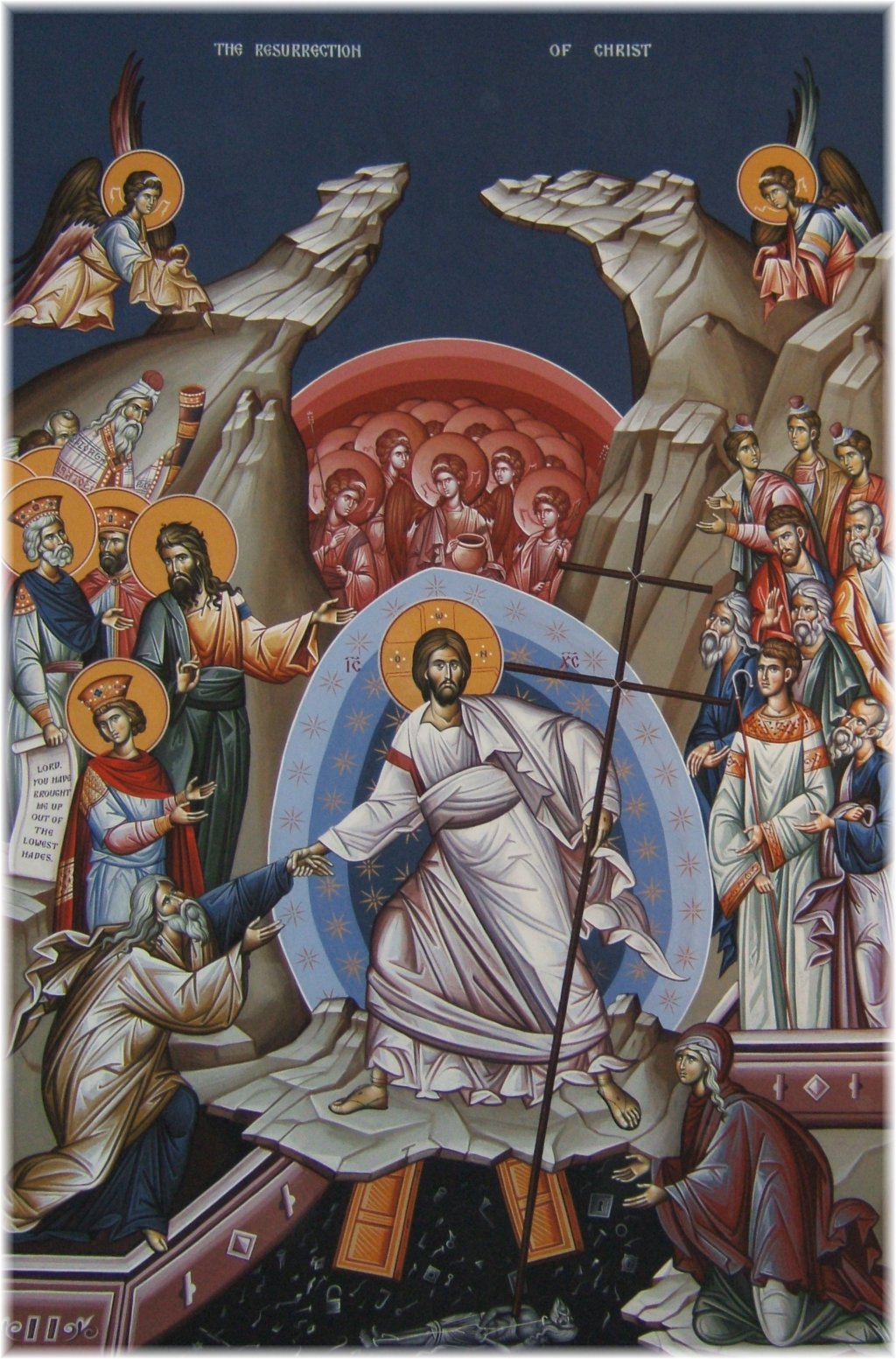


"If any man be devout and love God, let him enjoy this fair and radiant triumphal feast. If any man be a wise servant, let him rejoicing enter into the joy of his Lord. If any have labored long in fasting, let him now receive his recompense. If any have wrought from the first hour, let him today receive his just reward. If any have come at the third hour, let him with thankfulness keep the feast. If any have arrived at the sixth hour, let him have no misgivings; because he shall in nowise be deprived therefor. If any have delayed until the ninth hour, let him draw near, fearing nothing. If any have tarried even until the eleventh hour, let him, also, be not alarmed at his tardiness; for the Lord, who is jealous of his honor, will accept the last even as the first; he gives rest unto him who comes at the eleventh hour, even as unto him who has wrought from the first hour.
And he shows mercy upon the last, and cares for the first; and to the one he gives, and upon the other he bestows gifts. And he both accepts the deeds, and welcomes the intention, and honors the acts and praises the offering. Wherefore, enter you all into the joy of your Lord; and receive your reward, both the first, and likewise the second. You rich and poor together, hold high festival. You sober and you heedless, honor the day. Rejoice today, both you who have fasted and you who have disregarded the fast. The table is full-laden; feast ye all sumptuously. The calf is fatted; let no one go hungry away.
Enjoy ye all the feast of faith: Receive ye all the riches of loving-kindness. Let no one bewail his poverty, for the universal kingdom has been revealed. Let no one weep for his iniquities, for pardon has shown forth from the grave. Let no one fear death, for the Savior's death has set us free. He that was held prisoner of it has annihilated it. By descending into Hell, He made Hell captive. He embittered it when it tasted of His flesh. And Isaiah, foretelling this, did cry: Hell, said he, was embittered, when it encountered Thee in the lower regions. It was embittered, for it was abolished. It was embittered, for it was mocked. It was embittered, for it was slain. It was embittered, for it was overthrown. It was embittered, for it was fettered in chains. It took a body, and met God face to face. It took earth, and encountered Heaven. It took that which was seen, and fell upon the unseen.
O Death, where is your sting? O Hell, where is your victory? Christ is risen, and you are overthrown. Christ is risen, and the demons are fallen. Christ is risen, and the angels rejoice. Christ is risen, and life reigns. Christ is risen, and not one dead remains in the grave. For Christ, being risen from the dead, is become the first fruits of those who have fallen asleep. To Him be glory and dominion unto ages of ages. Amen."
- The Paschal Homily of St. John Chrysostom[27]


[1] i.e., the whole Gnostic revival in biblical academia – though there position is probably different than how I phrased it
[2] cf. N. T. Wright The Resurrection of the Son of God, Chapter 13
[3] Ibid, pp. 32-84. I know that this is a grand sweeping of many works, but I do not have room in this essay to engage with all the material. There were a few exceptions to this claim, but Wright deals with these in his book.
[5] cf. N. T. Wright The Resurrection of the Son of God and Dale Allison Resurrecting Jesus
[6] Wright, pp. 83
[7] Wright, pp. 689
[8] Ibid, pp. 687. A necessary condition is “something that has to be the case for the conclusion to follow: it is a necessary condition of my computer working properly that the house be connected to an electricity supply.”
[9] Ibid, pp. 690
[10] Ibid, pp. 690-1. It's hard to emphasize how radical the idea that Jesus was alive once again was in a pagan setting.
[11] Ibid, pp. 692
[13] Robert K. Wilcox, The Truth About The Shroud of Turin. pp. 15
[14] Ibid, 15-16
[15] Ibid, 16
[16] Ibid, 77
[17] Raymond N. Rogers, THE SHROUD OF TURIN: AN AMINO-CARBONYL REACTION
(MAILLARD REACTION) MAY EXPLAIN THE IMAGE FORMATION. pp. 1
[18] Ibid, pp. 6
[19] http://en.wikipedia.org/wiki/Shroud_of_Turin#cite_note-ReferenceA-133 referencing G. Fanti et alii, Microscopic and Macroscopic Characteristics of the Shroud of Turin Image Superficiality, Journal of Imaging Science and Technology—July/August 2010—Volume 54, Issue 4, p. 040201-6. I know it isn't good to cite things from Wikipedia, but I'm, at least currently, not willing to pay $20 for the article just to get the citation first hand. There are some posters on Dan Porter's blog who don't necessarily see this as completely ruling out Rogers' theory, but that his discovery is just part of the puzzle.
[20] Rogers, THE SHROUD, pp. 4. I'm more or less inferring this point rather than Rogers' having of stated it himself.
[21] It's also worth pointing out that, for those who are interested, theology doesn't allow for the corruption of Christ's body by death. The lack of any signs of putrefaction back this up which make me ponder if the Maillard reaction would even be viable theologically. This isn't as much a point to my argument as a thought done out loud.
[22] Raymond N. Rogers, FREQUENTLY ASKED QUESTIONS (FAQs). pp. 16
[23] Joseph Amalraj, Evidence of “Resurrection of Jesus” in the Shroud of Turin. pp. 1 http://www.shroud.com/pdfs/evidenceAmalraj.pdf  I'm a bit weary in including this information, not because of Amalraj, but because I'm not sure if it's been peer-reviewed or if there are any critiques of it. Nevertheless, food for thought.
[24] Ibid, pp. 1
[25] Ibid, pp. 1
[26] Or we'd already be saints and the charge of self-righteousness would be non-existent

Labels: , ,

Tuesday, January 24, 2012

Update and an Apology

Dear (few existing) readers,

I just would like to apologize again for the time between each essay. My current job with inner city youth takes up a large chunk of my day, and with my free time at home I try and give a good amount of it to my religious life. Hence, when the weekend comes, sometimes the last thing I want to do is research and write (Arkham City is just too much fun).

That said, I've been finishing up the final essay of the series which deals with the Shroud in the light of the Resurrection. This is very out of order to what I had initially stated. There's a few reasons for this. The first is the aforementioned schedule of my current life. The second is that, truth be told, I've grown slightly tired of using the Shroud as an apologetic tool -- not because I think its ineffective, but because my interest is theology and dogma and it's ecumenical implications. This blog, in all my arrogance, was originally made with such things as its intent (though I now, and thanks be to God for it, realize I was way in over my head (and arrogant) to think I could write about such subjects knowing as little as I do). I don't want to be caught up with the Shroud forever. The third is that any historical reconstruction I'd post would essentially be a giant 'Cliff Notes' version of Ian Wilson's book (much like the first essay was). For anyone wishing for a historical reconstruction, I highly suggest you buy it if you have a Kindle. If not, Robert Wilcox's book is a good substitute. That said, expect an update within the week!

Labels: ,

Sunday, January 1, 2012

Joe Nickel -- c'mon guy


So I'm sure that everyone who keeps up to date on the Shroud has heard about the recent experiments by ENEA which were able to reproduce the superficiality of the Shroud image using bursts of light. My point in writing this though is to show the blatant fallacious writings of skeptic Joe Nickell, who is repeating the same false facts that I heard far too many Shroud skeptics tout:

Given the tremendous evidence against the 'shroud' — its incompatibility with Jewish burial practices, lack of historical record, bishop's report of the forger’s confession, the still-bright-red 'blood' which failed forensic serological tests, the presence of pigments and paints throughout the image, three laboratories' radiocarbon dating of the cloth to the time of the confession (1260–1390), and much additional evidence — it would seem that Di Lazzaro is straining at a gnat and attempting to swallow a camel. Let him produce a shroudlike image according to whatever theory he can muster, and we'll talk again.”

Let's break this down line by line.

“Its incompatibility with Jewish burial practices” is patently false. Ian Wilson shows in his book how the word the synoptic writers (Mark, Matthew, and Luke) use – sindon – refers not to a burial cloth but just a general linen cloth. Furthermore, even though John said he saw 'the soudarion which had been over His head', the word he used for over – epi – doesn't necessarily mean that it had to cover only Christ's head, but that it could have covered His entire body as well (which is reinforced with what Jewish law mandated: that one who had blood pour forth from wounds would be wrapped in a sovev, a cloth that would wrap an entire body in the same way that a soudarion could).1

While the “lack of historical record” is true in a sense, the history of the Shroud has been reconstructed through various hints in records, alluding to an image of the Savior being venerated. We know of this happening in Constantinople all the way back to Edessa since the Shroud is probably what we knew as the Image of Edessa.2

The “bishop's report of the forger's confession” has long been seen as suspect because of power struggles surrounding the parties. People, unfortunately, can lie.3

The still-bright-red 'blood' which failed forensic serological tests” has been shown to be utterly false by the works of Adler and Heller, and can be read about in the article by David Ford that I posted on this blog earlier.

The presence of pigments and paints [found] throughout the image” has also shown to be false. See the above mentioned article.

The “three laboratories' radiocarbon dating of the cloth to the time of the confession (1260–1390)” are useless once we factor in that the piece that they tested was most likely a re-weave.

Whelp.


1cf. Ian Wilson The Shroud: Solving the 2000-year-old Mystery. Chapter 4: Window on the Passion
2cf. the above or Robert K. Wilcox's The Truth About the Shroud of Turin
3cf. the above mentioned

Labels:

Saturday, October 1, 2011

The Argument From the Shroud - The Anatomy of the Man (1-C)


In this post I'll be covering the anatomy of the man on the Shroud while attempting to show that the image depicts that of Jesus Christ (regardless of authenticity). I should note now that one cannot prove who the image belongs to, but when all the facts are accounted for we can easily infer that it depicts Jesus Christ.

We shall start from the top and work our way down. The first noticeable wounds are those on the crown of the man; they correlate to the puncture wounds that would have been made by a crown of thorns such as depicted in the gospel of St. Mark: “And they twisted a crown of thorns, put it on His head, and began to salute Him, 'Hail, King of the Jews!'”.1 In reality the crown is more akin to a cap2, thus going against artistic norms and therefore common-folk expectations.3 Already we should ask: why would a medieval forger go against the expected norms if he were forging the Shroud to trick others?4 However, this did not seem to stop people from believing the authenticity of The Shroud in the medieval era, but it is still something worth pondering about.

Moving to the face we immediately see the damaged nose and swollen right cheek.5 The wounds here seem to be too general as to identify exactly what caused them, though blows from fists seem to fit.6 This would correlate with the accounts of both Luke 22:637 and Matthew 26:67:

“Now the men who beheld Jesus mocked Him and beat Him. And having blindfolded Him, they struck Him on the face and asked Him, saying, 'Prophesy! Who is the one who struck You?'” Luke 22:63-64

Then they spat in His face and beat Him; and others struck Him with the palms of their hands, saying, 'Prophesy to us, Christ! Who is the one who struck You?'” Matthew 26:67-688

The man's hair is of longer length and fashioned into a braid while his beard is both short and forked.9 It is worth noting that this hairstyle was not from “Greco-Roman culture” but is Judaic.10 Likewise, the beard was “highly regarded...as a manly adornment” in Jewish culture.11

There also seems to be a square imprint in the middle of the man's forehead12 as well as a 'V' mark between his eyes.13 Paul Vignon, the man who first observed the Shroud, noted that “80 percent” “of Byzantine icons”14 of Christ had this same 'V' shape amongst other identifying characteristics, suggesting that “the shroud face and the face on the icons had more than a casual link to one another”.15 This important observation will be covered in another section.

Furthermore, the face of the man was identified by anthropologist T. Dale Stewart (who frequently identified people's race via bones for the FBI) as being “that of a white man” whose origin could be either Palestinian or Greek.16 Furthermore, Carlton S. Coon, a highly “distinguished ethnologist” identified the man of the Shroud as having “a physical type found in modern times among Sephardic Jews and noble Arabs”.17

Moving down to the torso area we see that the body of the man is covered in whip marks which indeed relate to the Gospel accounts.18 The device used to make these wounds was none other than the Roman flagrum, a dumb-bell-whip which was usually fitted with small sheep bones and twin pellets of lead – such specificity has been identified on the Shroud.19 There are around 100 individual dumb-bell marks20 – something that would have been completely unfeasible for an artist to replicate with such accuracy so many times (as Vignon himself remarked)21, let alone as a photographic negative.

The nakedness of the man is also historically accurate as we know from the accounts of Philo of Alexandria in which he reports that crucifixion victims were stripped naked before flogging.22 This seems at first to be a contradiction between the Gospel accounts and the Shroud, as both in the books of St. Matthew and St. Mark, Jesus' own clothes were put back on him after he was beaten. However, we also read in all four Gospel accounts how Christ's garments were divided amongst the Roman Soldiers who then casted lots for them. Thus Christ's clothes were stripped off Him at some point, again showing a correlation between the Gospel accounts and the Shroud of Turin.

Looking on, there is noticeable chaffing of the shoulders23 most likely from carrying the patibulum (crossbeam) on which the man was to be crucified (a common Roman practice).24 This is reported in the Gospel of St. John when the beloved disciple writes: “And He, bearing His cross, went out to a place called the Place of a Skull, which is called in Hebrew, Golgotha” (John 19:17).25 There is also damage to the man's knees, presumably from falling while carrying his patibulum.26 If the man on the Shroud is indeed Jesus Christ, this would make sense as St. Simon of Cyrene had to help Him carry His cross as reported in the Gospels of Saints Matthew, Mark and Luke27:

“Now as they came out, they found a man of Cyrene, Simon by name. Him they compelled to bear His cross.” (Matthew 27:32)

“Then they compelled a certain man, Simon a Cyrenian, the father of Alexander and Rufus, as he was coming out of the country and passing by, to bear His cross.” (Mark 15:21)

Now as they led Him away, they laid hold of a certain man, Simon a Cyrenian, who was coming from the country, and on him they laid the cross that he might bear it after Jesus.” (Luke 23:26)28

Next are the wounds in the wrists – not the hands. This, as most people can figure, again goes contrary to traditional Christian art29 where Christ is depicted as being nailed through his hands to the cross. Now this doesn't necessarily rule out the fact that the man was crucified through his hands as we only can see the exit wounds30. Regardless, this does not run contradictory to the account given in the Gospel of St. John31 as the word St. Thomas uses for “hand” includes the wrist area in the original Greek.32 The blood from the wrist also moves in a way that does not seem correct with the way the arms are positioned.33 This is because the blood flowed in such a way only if the man's arms were positioned at a 65 degree angle – an angle that is completely compatible with crucifixion.34

Lastly we'll look at a particular wound in the man's chest which has an “elliptic shape to its top edge”.35 Such a wound could have been caused by a bladed weapon of some kind.36 Ian Wilson further elaborates:

The Greek word the author used for ‘lance’ in this passage was lonche, the Latin equivalent was lancea; Archaeologically we know quite a lot about the lancea. With a long leaf-like blade thickening and rounding off towards the shaft, it was just the kind of general-purpose weapon that would have been standard issue for the small contingent of auxiliaries who took direct charge of Jesus’s crucifixion (pl. l1b). In the Landesmuseum in Zurich there are several good examples with essentially exactly the same elliptic breadth to the blade that we can see on the Shroud.”37

The area targeted is where Roman soldiers were trained to stab since it is the arm in which their enemy would be holding their weapon and not their shield38 (as seen in the “Dying Gaul” statue).39 This relates to the account in the Gospel of St. John when Jesus is stabbed with the Lance of Longinus: “But one one of the soldiers pierced His side with a spear, and immediately blood and water came out.” (John 19:34) Furthermore, the area in which the wound appears “showed [a] separation of blood parts, including serum”.40

Furthermore, the blood flows on the Shroud are surprisingly realistic and again go against usual artistic depiction; the “flows follow the natural contours of the body” while “artists...usually depicted such flows in straight lines or stylized droplets”.41 It is worth noting that such a torture technique was not typical of either Roman practice or that of any other culture and that Jesus is the only one known to have received said torture42.

There are other facts that we could go into (as well as further elaboration on the ones discussed here) but I think that this is sufficient to establish vast correlations between the man on the Shroud and Jesus Christ. There is no other person in history or legend that has suffered all these wounds in the same exact matter, and the perfect correlation makes it highly plausible to reason that this man is at least a depiction of Jesus Christ. To invent any other character would seem to be completely illogical as they would be nothing more than pure fiction43 compared to the person of Christ, who even if one does not accept his historicity, must submit to the fact that there is a long oral and written tradition about Him. Thus, at this point, I put forward that we can reasonably deduce two things:
  1. The man on the Shroud is a depiction of Jesus Christ
  2. The Shroud does not seem to have been any kind of medieval forgery
If we agree with these two premises (as I argued in this and my last essay) then I think we can start to consider the fact that this indeed is the Shroud of Jesus Christ and that the image was made from his body (whether by natural or supernatural means). However, at this point we need to show at least some kind of a timeline that the Shroud could be traced back through (though, as I showed in my first essay, we have good reason to believe that this Shroud dates from antiquity). But even before that, we need to answer the elephant in the room:

What went wrong with the Carbon Dating?


1Ian Wilson The Shroud: The 2000-Year-Old Mystery Solved, 2010. Kindle Locations 955-957. All Scripture quotations are NKJV from The Orthodox Study Bible
2Robert K. Wilcox The Truth About The Shroud of Turin, 2010. pp. 17
3Ibid.
4Ibid.
5Robert Bucklin, M.D., J.D., An Autopsy on the Man of the Shroud http://shroud.com/bucklin.htm
6Wilson, kl. 947-948
7Ibid., kl. 5834
8Wilcox, pp. 18
9Bucklin
10Wilcox, pp. 144
11Ibid.
12Bucklin
13Wilcox, 101.
14Ibid, pp. 101
15Ibid, pp. 100
16Ibid., pp. 143, 146
17Ibid., 147
18Wilson, kl. 965-967
19Ibid., kl. 977-980
20Ibid, kl. 982-983
21Wilcox, pp. 18
22Wilson, kl. 974-975
23Ibid., kl. 988-989
24Ibid., kl. 995-996
25Ibid., kl. 989-991
26Wilcox, pp. 19
27Wilson, kl. 991-993
28Ibid., kl. 5849
29Wilcox, pp. 17
30 Frederick T. Zugibe, M.D., Ph.D., Pierre Barbet Revisited, http://www.shroud.com/zugibe
31Wilson, kl. 1006-1008
32Ibid., kl. 5852. “So he said to them, 'Unless I see in His hands the print of the nails, and put my finger into the print of the nails, and put my hand into His side, I will not believe.” (John 20:25)
33Bucklin
34Ibid.
35Wilson, kl. 1048-1049
36Ibid., kl. 1049
37Ibid., kl. 1052-1056
38Ibid., kl. 1060-1062
39Ibid., kl. 1062-1064
40Wilcox, pp. 19
41Ibid., pp. 16
42Wilson, kl. 959-960, 962-964
43Ibid., pp. 26 “But those who wish to attribute the shroud to another person are in the same condition as ourselves with respect to the other difficulties, with this difference – that their person is a pure invention without any mention in history, tradition or legend.” - Prof. Delage

Labels: , ,

Monday, August 29, 2011

The Argument From the Shroud Index


Introduction

Part 1: It's Characteristics
A) The Shroud Itself
B) The Image's Characteristics
C) The Anatomy of the Man
D) Further Reading

Part 2: It's History
A) The Carbon Dating


Part 3: Pascha
A) 'O Death, where is thy sting? O Hades, where is thy victory?'

Labels: , , ,

Sunday, August 28, 2011

The Argument From the Shroud - The Image's Characteristics (Part 1-B)


Please read the post not on the home page (where you can see multiple posts at once) but only on its own page (you can only see the post). If you choose to read it with other posts available the hyperlinks for the footnotes won't work correctly.

This post will move on to the properties of the body image. When I mean properties, I'm referring to UV waves, chemical tests, etc; any kind of anatomical analysis will be saved for another post.

Note: Supposedly Joe Nickell, infamous Shroud skeptic, has been able to manually reproduce such an image using available painting techniques (see his book), however comments alone already start to show that his claims are false (he is also not well regarded in the area of Shroud Research), though at the same time others seem to defend his claims. The problem with Nickell, though, is that he relies off of Walter McCrone's non-peer-reviewed research which has been thoroughly debunked -- but I'm getting off topic now (just remember, continue to research for yourself!).

Photographic Negative

The first thing we should notice is that the Shroud is a photographic negative. This was discovered by Secondo Pia , an amateur photographer, when he was developing pictures of the Shroud that were commissioned by the Vatican.1 What this means is while one can see the image of a man on the Shroud, the image's lifelike qualities do not show up until one sees the negative of the image. We already need to ask: how could a painter do this when the concept of photographic negativity did not come until well after the middle ages?2 If a relic-forger really wanted to stump people it would make far more sense to paint it as a positive, something that people would identify with.3

However, this alone doesn't prove anything as people did indeed believe that the Shroud was the genuine burial cloth of Christ long before Secondo's discovery. Even still, the sheer amount of detail, as we'll see more in the anatomical section, would be incredibly hard for an artist to replicate in the form of a negative, let alone both the front and the back body images as well as hundreds of years before photography.

Second Face

Another startling discovery about the Shroud is the 'second face' discovered by Fanti and Maggiolo.4 On the backside of the Shroud which was not able to be accessed for some time, actually contains the face of the man on the front side in a much fainter image which can be seen with “Gaussian filters, Fourier transforms and template matching”.5 Furthermore, the properties of the image on the back, specifically the superficiality of the image (discussed below) is exactly the same on the front's, meaning that both images were produced by the same unknown process.6

Superficiality

The image on the Shroud is superficial; in other words, the image only colors the top of the threads.7 This is opposed to paintings in where paint would seep through multiple levels of the fibers when applied8 Furthermore, the image-bearing fibers:

“do not penetrate the cloth, nor do they exhibit any capillarity or absorptive properties. They are more brittle than their non-image counterparts, as if whatever formed them lightly corroded them. They are uniform in coloration. They are not cemented together, neither are they ‘diffused’ as they would be if they derived from some dye or stain. They do not ‘fluoresce’ or reflect back any light. Most emphatically, they are not made by any pigment.”9


Furthermore, “biophysicist John Heller (d. 13 December 1995) and chemist Alan Adler (d. 11 June 2000) concluded that the body image consisted simply of prematurely-aged linen” and not of any kind of paint pigment.10 Also, wherever there was blood, the fibers lacked these very characteristics – in other words the painter would have had to put the blood on first and then paint the negative11.

3D-Properties

The image also exhibits 3D-image properties when analyzed by a VP-8 Image Analyzer, a device that uses levels of white and black to make “a vertical relief”.12 However, photographs usually do not encode this information since they only record shades of light and nothing about distance.13 Hence when photographs are normally put into a VP-8 image analyzer they come out “almost invariably collapsed and distorted” since “the VP-8” was not “designed or intended to produce any ‘true’ 3D display, only a semblance of it”.14 When the Shroud was put through though, a “consistent ‘true’ 3D effect was produced”, one whose very contours were visible.15 The inventor of the VP-8 Image Analyzer, Peter Schumacher, said:

“‘A “true three-dimensional image” appeared on the monitor . . . The nose ramped in relief. The facial features were contoured properly. Body shapes of the arms, legs and chest and the basic human form . . . I had never heard of the Shroud of Turin before that moment. I had no idea what I was looking at. However, the results are unlike anything I have processed through the VP-8 Image Analyzer, before or since. Only the Shroud of Turin has [ever] produced these results from a VP-8 Image Analyzer.’”16

The Painting Hypothesis

So our medieval forger now not only has produced a photographic negative without using paint, was able to create a “ghost” image that mirrored the front side of the Shroud, was able to paint both the front and the back of the man without any visible mistakes, was able to do all of this after blood had been put down on the Shroud, but he was also able to encode 3-Dimensional properties into the Shroud that are not found in other works and would not have been able to be appreciated for another 650 years.17 Furthermore, this man would have had to paint the Shroud without any signs of brush strokes18 as well as at a distance, for the man on the Shroud can only be seen when viewed from afar; up close, the image is not visible19.

The theory that the Shroud is a painting is less credulous the more we pour into the science; when the Shroud underwent it's first detailed examination by Paul Vignon, he concluded that “The impressions on the Holy Shroud are produced by chemical action, largely without absolute contact between the body and the cloth. Of this we have no doubt.”20 What Vignon, an amateur artist himself, failed to find was any signs of paint21. Furthermore, Vignon tried making a replica himself, but found that whenever he tried to simulate the wear and tear that the Shroud had gone through, the paint would fall off, leaving his image significantly different than that of the Shroud's, let alone the vast information the Shroud contains in its image22 (more on this in later sections). Yves Delage, professor of Vignon, would go on to give his presentation on the Shroud “to the French Academy of Sciences” stating that there were no signs of paint or artistic preparation23, and that the Shroud was the genuine Shroud of Christ.24 He personally believed that the vaporograph theory was what made the image on the Shroud.25

A further problem for the painting hypothesis is that linen is a tough substance to paint on, especially because it is water resistant.26 To consider what we have learned thus far as well as all the anatomical information that is to come and to then say it was all painted on such a difficult substance seems highly unlikely. Furthermore, the darker colored “lines” which make up the image are roughly “1/100th the width of a human hair”, something that is impossible to have been painted by an artist manually.27 There is also a lack of definite edges and an artistic style, something that we'd expect to see if the Shroud was a painting28 as well as foreshortening, an artistic concept which was not used until the Renaissance.29


Footnotes:
1 Robert K. Wilcox The Truth About The Shroud of Turin, 2010. pp 3
2 The concept of negativity did exist prior to the medieval ages, but it was different than today's. Cf. Izabel Piczek The Concept of Negativity Through the Ages vs. The Negative Image on the Shroud http://shroud.com/piczek3.htm
3 Wilcox pp. 11
4 http://www.shroudstory.com/faq-second-image.htm citing Fanti & Maggiolo 2004
5 Ibid
6 Wilcox pp. 229-230
7 Ian Wilson The Shroud: The 2000-Year-Old Mystery Solved, 2010. Kindle Locations 1252-1253; Evidences citing Evans 1978; Pellicori 1981, p. 4
8 Personal discussion with Dr. Fotios Papadimitrakopoulos, associate Director, Institute of Materials Science Professor, Chemistry at the University of Connecticut
9 Wilson, Kindle Locations 1253-1256
10 David Ford, The Shroud of Turin's 'Blood' Images: Blood, or Paint? A History of Science Inquiry, 2000. pp. 2 citing Jumper et al., 456; Murphy, 65; Lavoie, 58-9; Heller (1983), 200.
11 Wilson, Kindle Locations 1261-1262
12 Ibid, Kindle Locations 533-534
13 Ibid, Kindle Locations 534-535
14 Ibid, Kindle Locations 536-537
15 Ibid, Kindle Location 538
16 Ibid, Kindle Locations 545-550, citing Schumacher, 1999
17 Ibid, Kindle Locations 553-554
18 Fanti, G. et al, Evidences for Testing Hypotheses About the Body Image Formation of the Turin Shroud , citing Lorre 1977, pp. 9 http://shroud.com/pdfs/doclist.pdf
19 Kilmon, J., The Shroud of Turin: Genuine artifact or manufactured relic?, The Glyph, the journal of The Archaeological Institute of America, San Diego, Vol 1, No. 10 (Sept 1997); No. 11 (Dec 1977); No. 12 (March 1998). Reproduced at http://www.historian.net/shroud.htm
20 Schneider, R. The Shroud of Turin: A Mystery Wrapped in an Enigma – Shroud Science, Slide 12 https://docs.google.com/present/view?id=0AcPCQzmpKvr2ZG1xbmo4d18wZnNnbm01Zmc&hl=en&authkey=CN-wtYoL&pli=1citing The Shroud of Christ by Paul Vignon, 1902. pp. 154 English Version
21 Wilcox, 11
22 Ibid
23 Schneider, R. Slide 13
24 Wilcox, 28. Interestingly enough, Delage experienced a giant backlash for his conclusion and reprimanded the Academy, feeling that if it were not Christ that was in question, no one would bother to challenge his conclusion (Delage himself was not a Christian).
25 Schneider,R. Slide 13. A brief explanation of this theory is on Slide 14 of the same presentation.
26 Sorensen,R. Summary of Challenges to the Authenticity of the Shroud, pp.3 http://shroud.com/pdfs/sorensen2.pdf
27 Ibid
www.shroud.com/piczek3.htm for the lack of artistic style
28 Ibid
29 Ibid, citing Is the Shroud of Turin a Painting?, www.shroud.com/piczek.htm

Labels: , ,